 Audio Flashcards
 Peter from Audio Flashcards · 27 October 2026
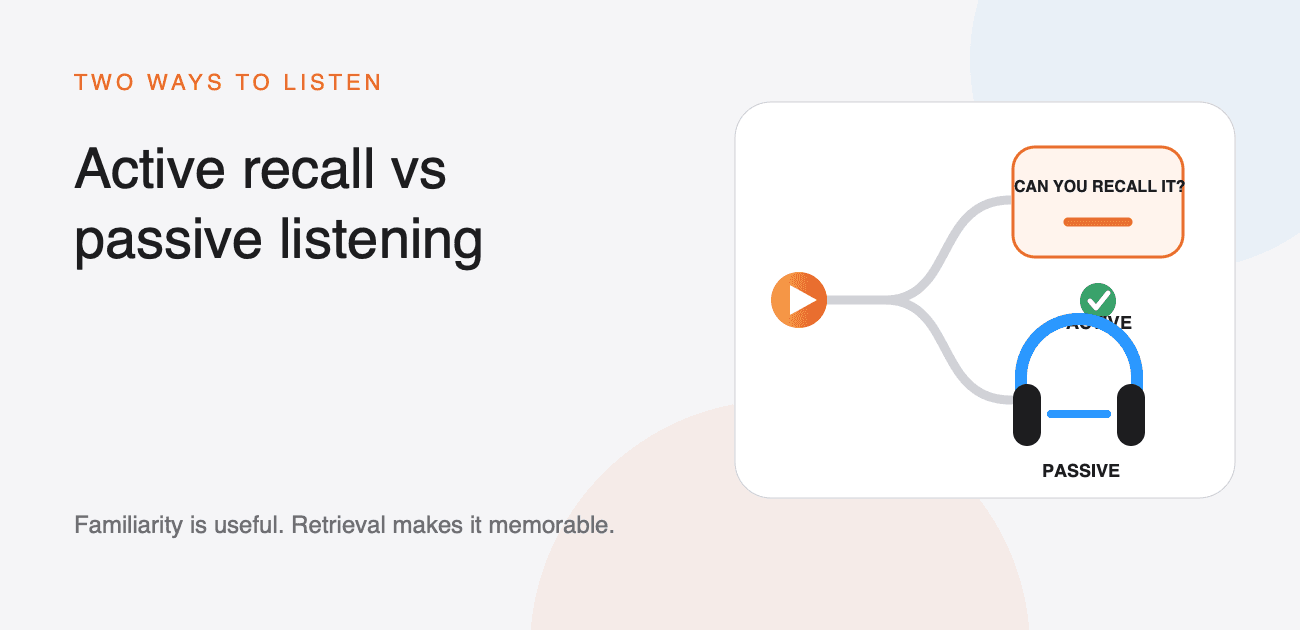
Hearing information repeatedly can make it feel familiar. Active recall asks a harder question: can you produce the answer before it is played?
Both experiences can be useful, but they provide different evidence about memory. An audio flashcard session should not assume that a card was remembered merely because its audio finished.
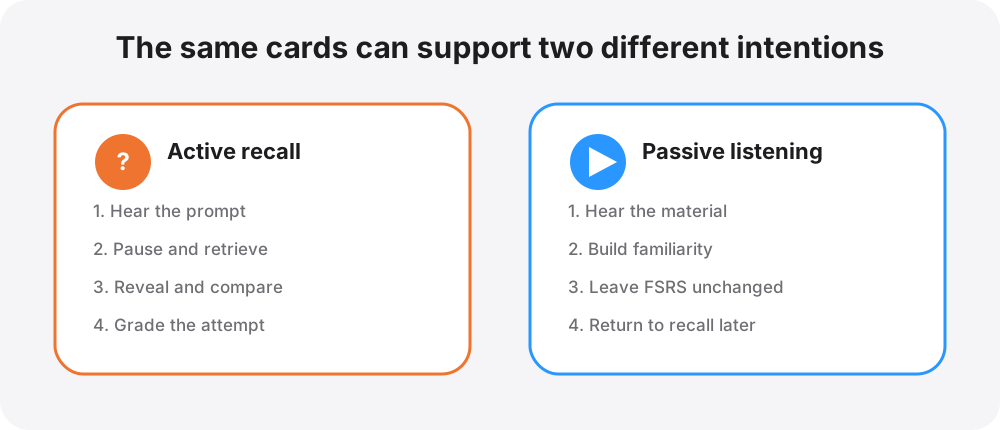
What active recall looks like
An active review has a deliberate gap:
- hear a focused question;
- attempt the answer without help;
- reveal and compare the real answer; and
- grade the attempt.
The grade tells the scheduler what happened. Again, Hard, Good, and Easy lead to different future intervals because they describe different levels of retrieval.
Speaking the answer aloud can make the attempt clearer, but it is not required. Answering in your head still counts as recall if you commit to an answer before the reveal.
How audio flashcards work describes the complete review loop and the role of each grade.
What passive listening looks like
In a listening session, cards play while your attention may move elsewhere. You might follow every question, or only notice parts of the sequence. The material receives exposure, but the app cannot know whether you attempted each answer.
Listening can be useful for:
- becoming familiar with the sound and rhythm of new material;
- revisiting phrases or terminology during low-attention time;
- practising pronunciation models; and
- keeping a large set in circulation between focused reviews.
It is weaker evidence for recall. Familiarity can make an answer feel known when it would still be difficult to produce from a blank prompt.
Why an ungraded play does not move the FSRS schedule
Audio Flashcards records a graded review only when you choose Again, Hard, Good, or Easy. If autoplay, a skip control, or a voice command moves past the card without a grade, its FSRS due date normally stays where it was.
That protects the active schedule. A card heard while you were distracted is not silently marked as remembered.
During a Review explains graded and automatic passes in the player.
The passive scheduler
A listening session can still need spacing. Without it, the same first cards may play whenever the active schedule says they are due, even though you want broader background exposure.
The optional passive scheduler gives ungraded plays their own curve. It can move listened-to cards through a session without changing their FSRS review history. Configure it per saved session, so an active daily review remains strict while a walking or background session behaves differently.
The controls and their relationship to FSRS are documented in Passive Scheduling.
Use separate sessions for separate intentions
A simple setup is:
- Daily Review: due cards only, autoplay if desired, voice commands on, graded answers, progress recorded.
- Listen: a broader collection, longer continuous playback, passive scheduler on, no expectation that every card will be graded.
- Practice: a chosen set before an exam or presentation, progress not recorded.
Saved Review Sessions keep those settings separate instead of asking you to reconfigure the player every time.
Turn listening into recall when attention allows
Even inside a listening session, you can create brief moments of active recall. Pause after the question, say the answer, and grade the card if you were genuinely paying attention. When the environment becomes demanding, let the session continue without a grade rather than guessing one.
That distinction is more useful than trying to label the entire activity as active or passive. The signal belongs to each card.
Check whether the cards work by ear
Long explanations are easy to let wash past. For active recall, make the question precise and the expected answer small enough to hold in working memory. Split cards that ask for several unrelated facts.
Writing Good Cards adapts practical flashcard-writing rules for spoken prompts. Better cards improve both focused reviews and listening sessions because their purpose remains clear without the screen.