 Audio Flashcards
 Peter from Audio Flashcards · 27 October 2026
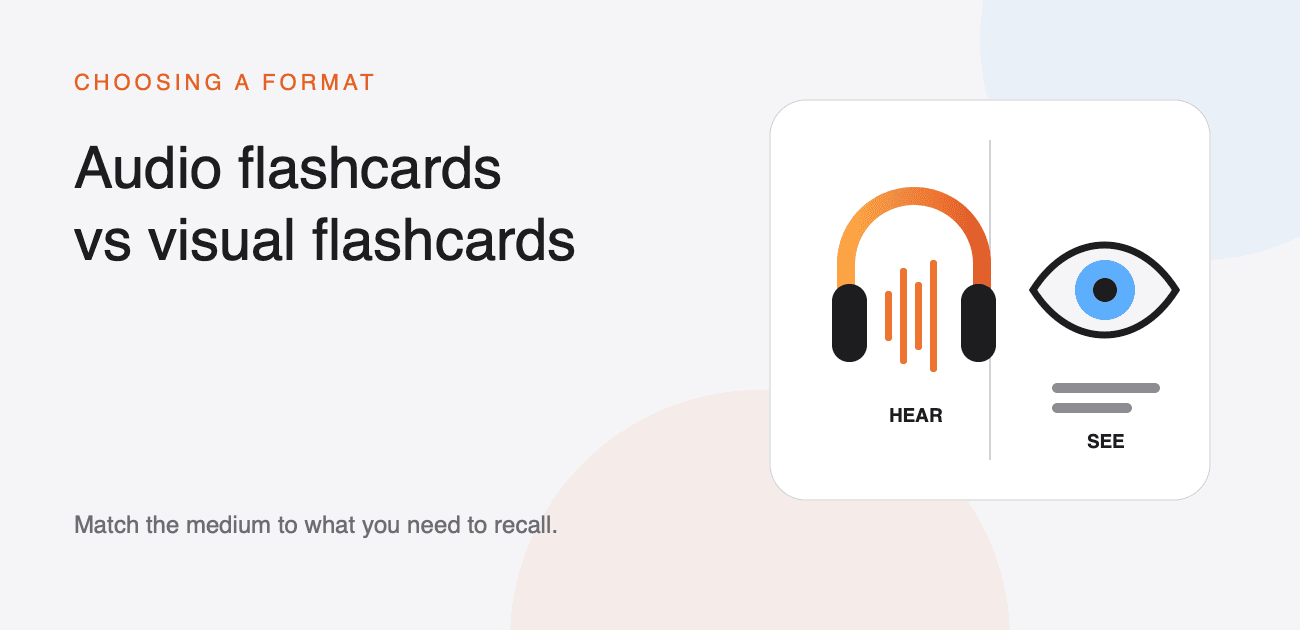
Visual flashcards ask you to look at a prompt and reveal a written or pictured answer. Audio flashcards ask you to hear the prompt and reveal a spoken answer. Both can use active recall and spaced repetition; they simply present the material through different senses.
Neither format is universally better. Audio is strongest when the sound itself matters or when you cannot keep looking at a screen. Visual cards are strongest when layout, spelling, notation, or an image carries essential information.
When audio flashcards fit
Audio works well for:
- vocabulary, pronunciation, and listening comprehension;
- names, definitions, sequences, and short explanations;
- oral exams, scripts, and professional terminology;
- music, bird calls, and other sounds that cannot be represented well by text; and
- review during a walk, commute, workout, or household task.
Because the prompt is spoken, you cannot accidentally read part of the answer from the shape of a word. You have to recognise the sound and retrieve the response.
The main constraint is that spoken information is temporary. If a card contains a long list or a complicated sentence, you may forget the beginning before the end arrives. Writing Good Cards shows how to keep prompts atomic and easy to follow by ear.
When visual flashcards fit
Visual cards are usually a better starting point for:
- diagrams, maps, anatomy, and labelled images;
- equations and notation;
- spelling, scripts, and punctuation;
- code where exact characters and indentation matter; and
- information that must be compared side by side.
Reading also lets you pause at any point and scan backwards. With audio, that usually means replaying the side.
The learning method matters more than the medium
An audio track playing in the background is not automatically active learning, just as looking at a written answer is not automatically a good review. In both formats, the useful sequence is:
- receive a focused prompt;
- attempt the answer before revealing it;
- compare your recall with the answer; and
- record how difficult it was.
That grade lets spaced repetition choose an interval based on memory rather than simply repeating every card equally. How audio flashcards work explains the complete loop.
A mixed approach
Many subjects need both formats. A language learner might read a new word and its spelling at a desk, then review its sound and meaning on a walk. A medical student might learn anatomy from a diagram and use audio cards for definitions, pathways, or oral exam prompts.
Audio Flashcards keeps text with recorded and generated sides, so you can show words when the screen is available without making them necessary for playback. Transcribed recordings can also be searched later. See Search & Transcription for how spoken words become searchable.
Questions to ask before choosing
For each piece of material, ask:
- Do I need to recognise this by sound?
- Does seeing the spelling or layout give away the answer?
- Would the answer still make sense without a screen?
- Is this one recall task, or several facts packed together?
- Where will I realistically review it?
If the content makes sense through headphones and you can answer it in one thought, it is a good candidate for audio. If the structure must remain visible, keep it visual or use both.
Try the same material both ways
Take five familiar cards and speak their prompts and answers aloud. If they remain clear without seeing the page, make an audio version and try a short autoplay session. If they become confusing, shorten the wording or keep the visual cues.
For a practical walkthrough, How to make audio flashcards covers recording, text-to-speech, bulk import, and the first review.