 Audio Flashcards
 Peter from Audio Flashcards · 28 October 2026

You recognise a word when you hear it. An explanation makes sense while you are reading it. But when you need the answer later, it is harder to bring to mind.
Spaced repetition and active recall help you practise that missing step: remembering something when the answer is no longer in front of you. Together, they have a strong foundation in learning research.
Audio Flashcards turns them into a simple routine. Hear a question, try to answer, check your response, and return to the card over time. FSRS helps decide when that next review should happen.
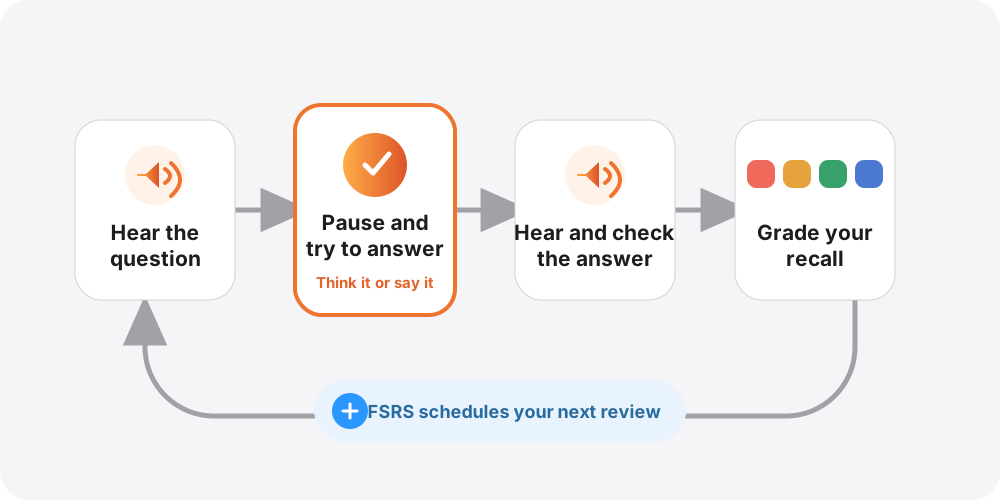
Use the pause to recall the answer, then check it and tell the scheduler how you did.
Why spacing your reviews helps
Spaced repetition means returning to information after gaps between learning sessions. You might meet a new word today, review it on another day, and revisit it again as you become more familiar with it.
A major review of distributed-practice research examined 317 experiments. It found that spreading learning episodes out generally improved later memory. It also found that the most useful gap depended partly on how long people needed to retain the material.
That means there is no universal sequence such as “review after 1, 3, 7, and 14 days” that is best for every card and every goal. Preparing for next week and maintaining knowledge for a year are different problems.
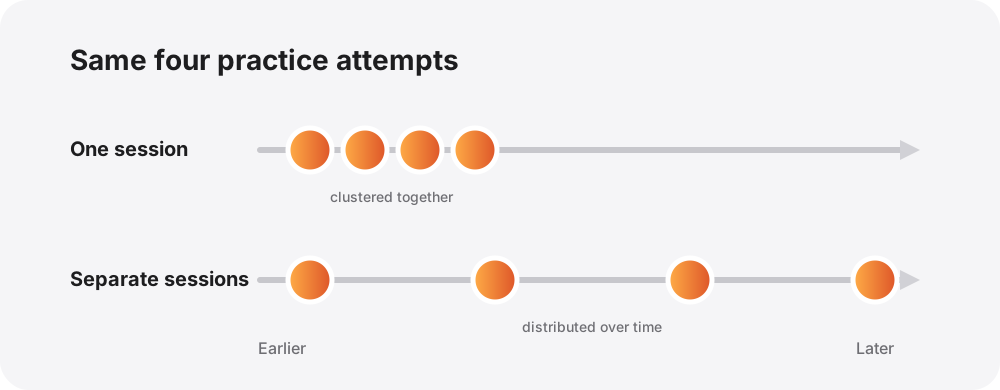
Spaced practice changes when the reviews happen, not how many attempts are shown here.
Why trying to answer matters
Active recall means attempting to bring an answer to mind before seeing or hearing it again. The effort is useful because it gives you practice at the thing you will need to do later: retrieve the answer without a prompt.
The evidence extends beyond laboratory word lists. A 2021 meta-analysis of classroom research combined 222 studies involving 48,478 students. Quizzing improved academic achievement by about half a standard deviation on average. The size of the benefit varied with the comparison activity, feedback, repetitions, and how closely the practice matched the later assessment.
This is where the pause in an audio flashcard matters. Suppose you hear, “What is the capital of New Zealand?” Use the gap to produce an answer in your head or out loud. Then listen to “Wellington” and check whether you were right.
If the answer plays before you have tried, you have had another exposure to the information, but missed that opportunity for retrieval. A separate meta-analysis of spaced retrieval practice found that spreading retrieval attempts over time improved later retention compared with concentrating those attempts together.
How FSRS chooses the next review
FSRS stands for Free Spaced Repetition Scheduler. It uses the timing and grades in a card’s review history to estimate three useful quantities:
- Difficulty: how hard the card is to learn.
- Stability: how long the memory is expected to remain strong.
- Retrievability: the estimated chance that you can recall it now.
These are modelled estimates, not direct measurements of a memory in your brain. After each graded review, FSRS updates its estimates and chooses an interval intended to meet your desired retention.
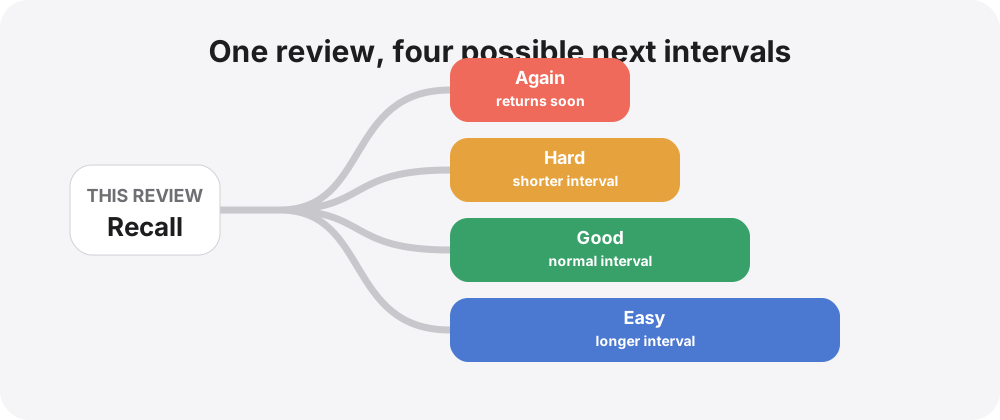
Your recall helps determine when the card returns. The actual interval depends on the card’s history and your review settings.
Use Again when you could not recall the answer, Hard when you recalled it with difficulty, Good for normal recall, and Easy when the answer came with little effort. Grade what you remembered before hearing the answer. Two cards given the same grade can receive different intervals because their histories differ.
What desired retention changes
Desired retention is the probability of recall FSRS aims for when a graded review becomes due. Audio Flashcards starts at 90%: roughly a nine-in-ten estimated chance of remembering the card at review time.
A higher target usually means shorter gaps and more reviews. A lower target permits longer gaps but accepts more forgetting and relearning. Moving the target towards 100% can increase workload sharply, so the highest possible value is not automatically the most useful one.
The target is an operating choice, not a scientifically established optimum for everyone. Pick a workload you can sustain and change it deliberately rather than chasing day-to-day fluctuations. FSRS Scheduling and Retention Settings explains the controls in Audio Flashcards.
What the evidence says about FSRS
FSRS has a serious technical foundation and strong evidence that it can predict recall. The public SRS benchmark uses review histories from 10,000 Anki users. Its main evaluation without same-day reviews contains about 350 million later reviews; models are fitted on earlier data and tested on later data. FSRS performs well in those prediction tests.
Prediction is valuable, but it is not the same as proving a particular gain in learning. A scheduler must also decide which card to show, when to show it, and how to balance retention against time and workload. A model can predict recall accurately without a benchmark telling us how many extra facts a person will learn or how much study time they will save.
The official project explicitly describes its often-quoted estimate of 20–30% fewer reviews as simulation-based. It should be treated as a model-based estimate, not a guarantee for every learner. Simulation and large retrospective datasets are useful evidence, but direct human comparisons of current FSRS with other capable schedulers remain more limited than the research on spacing and retrieval practice themselves.
The practical conclusion is still positive: FSRS is a well-founded way to manage review timing. The strongest established benefits come from what you do around that schedule: returning to material over time, attempting an answer, checking it, and grading honestly.
Make each audio review count
- Keep each question focused. Ask for an answer you can judge clearly. Split cards that contain several unrelated facts.
- Leave enough time to think. A vocabulary prompt may need a short pause; an explanation may need longer. Adjust the answer delay to fit the card.
- Commit before the reveal. Think or say an answer before the solution plays. Familiarity after hearing an answer is not the same as recalling it first.
- Grade the attempt you actually made. If you were distracted and did not try to recall the answer, do not invent a grade. Audio Flashcards can keep passive listening separate from graded FSRS reviews.
- Use mistakes as information. If a card keeps returning, check whether it is ambiguous, too broad, or based on something you do not yet understand.
- Choose a sustainable workload. Start with a manageable collection and add new cards gradually. A schedule only helps if you can return to it.
For more practical advice, see Writing Good Cards and Active recall vs passive listening.
Start with something you want to remember
Choose a few questions that matter to you: words for a conversation, concepts from a course, or knowledge you want available at work.
Make the questions clear, leave yourself time to answer, and check what you recalled. Let FSRS organise when you return to them.