 Audio Flashcards
 Peter from Audio Flashcards · 28 October 2026

A walk can be a useful time to practise a language, revise for an exam, or revisit something you learned earlier in the week. With audio flashcards, you hear a question, take a moment to answer, then check your response without needing to look at a screen.
Research suggests that learning and physical activity can fit together. Some studies find a small memory benefit from learning while walking; others find similar results during exercise and sitting. The extra benefit from movement itself is uncertain.
What you can control is how you use the time: choose material you can follow comfortably, try to recall each answer, and return to it later.
What the research says
One particularly relevant study followed trainee doctors listening to educational podcasts. In a randomised crossover trial involving 96 emergency-medicine residents, participants listened to one 30-minute podcast while exercising and another while seated without distractions.
Their immediate test scores were similar: 74.4% after exercise and 76.3% after sitting. A month later, the scores were almost identical at 52.3% and 52.5%. The study suggests that exercising did not meaningfully harm or improve retention in that setting. It did not track exercise intensity, so it cannot tell us how every kind of workout would affect learning.
Smaller vocabulary experiments have found a benefit from walking. In two within-person studies, people heard 40 unfamiliar word pairs while walking slowly on a treadmill and another set while sitting. They recalled roughly one additional word after walking in each experiment.
Results are not uniformly positive. In a study of slow treadmill-desk walking, participants learned slightly fewer words during the initial trials than seated participants, although their short- and long-delay recall did not differ significantly.
Different participants, movements, learning tasks, and memory tests can produce different results. The practical conclusion is modest: walking can be a reasonable setting for audio study when the task still leaves you enough attention to answer. You do not need to assume that movement automatically makes a session more effective.
Give yourself time to recall
The gap between a question and its answer is where you get the chance to practise remembering. If the answer arrives immediately, you can recognise it without finding out whether you could have produced it yourself.
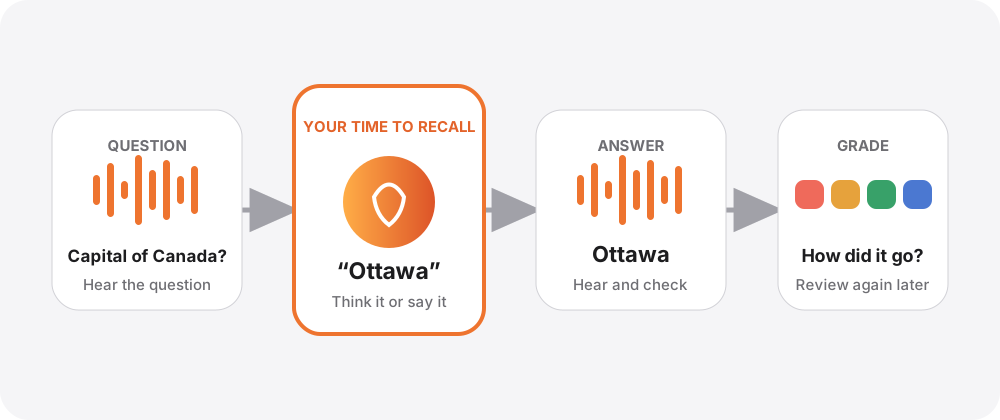
Leave enough time to attempt an answer before you hear it.
Trying to retrieve information from memory is called retrieval practice, or active recall. A large meta-analysis of classroom research found that quizzing improved later achievement across many subjects and age groups. The result is about attempting answers and receiving useful feedback, not about walking in particular.
For an audio card, the sequence is straightforward:
- Hear the question.
- Try to answer before the response plays.
- Listen to the answer and check what you remembered.
- Grade your attempt and revisit the card later.
In Audio Flashcards, adjust the answer delay to suit the material. A short fact may need only a few seconds; a definition or explanation may need longer. Choose a pace that lets you finish your attempt before the answer begins.
Choose material that works by ear
A useful walking card should make sense without its title, a diagram, or other text on the screen. Try playing a few cards with your phone face down. If a question leaves you wondering what “it” or “this” refers to, rewrite the prompt to include the missing context.
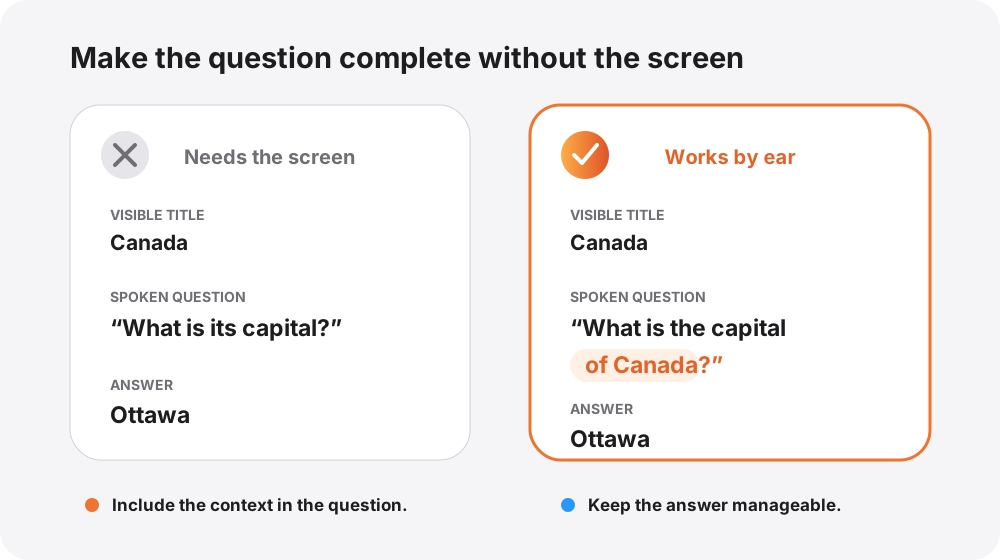
A useful audio card gives you enough context to answer without looking at the screen.
Short vocabulary prompts, definitions, and focused questions are convenient starting points. Keep each answer manageable. If one card asks you to explain an entire chapter, split it into questions you can answer and check separately.
Save diagrams, calculations, spelling practice, and anything you need to inspect closely for a session where you can see and work with it. If a new topic is difficult to follow while moving, pause the audio or return to it when you can give it more attention.
Build a walking review session
Start with one manageable set of cards and a familiar route. Configure the session before you leave, and pause whenever your surroundings need more attention.
Choose an easy pace that leaves you able to think through each question. If you notice that you have stopped trying to answer and are simply letting the audio run, slow the session, shorten it, or switch to easier material.
Audio Flashcards can play the question and answer automatically, with a delay you choose. Voice commands let you grade cards without returning to the screen. Headphone and Lock Screen controls offer alternatives when speaking aloud is inconvenient. Test the timing and controls while stationary before relying on them outside.
The hands-free study guide explains autoplay, voice commands, headphone controls, and what happens when a card finishes without a grade.
Base each grade on the answer you actually produced. An explanation that sounds familiar after you hear it does not tell you whether you recalled it beforehand. If you missed a question because your attention was elsewhere, replay it when you can focus or leave it ungraded.
Then return to the material on another day. Spacing reviews over time has a much stronger evidence base than any claim that a particular walking routine will improve memory.
Studying before or after exercise
You do not have to combine studying and movement. Exercise before or after a focused learning session may also help.
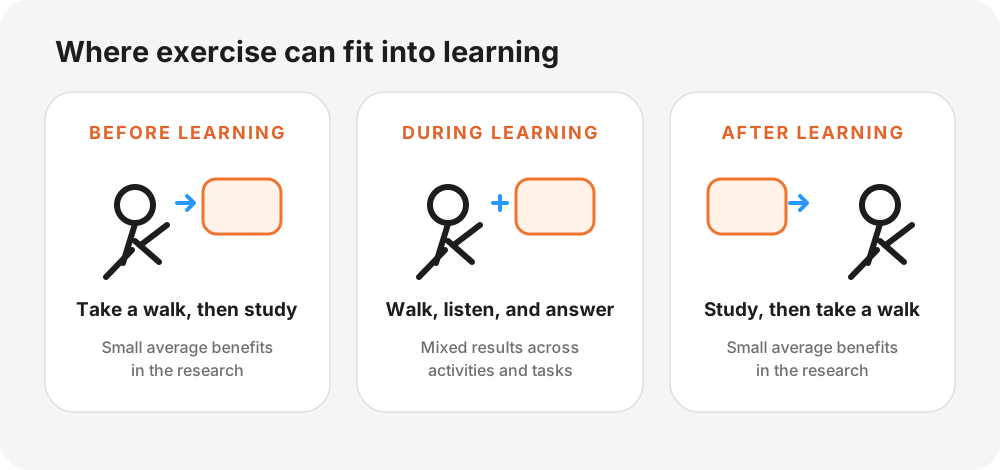
Exercise can fit before, during, or after a study session. Its effects on memory vary with the activity and learning task.
A systematic review and meta-analysis of 42 experiments found small average memory benefits when acute exercise happened before or after learning. Exercise during learning showed no overall benefit. The effects differed by the type of exercise and memory test.
Those averages do not establish a single best routine. A practical option is to take a walk, then sit down with challenging new material. Another is to study first and use a later walk for audio review. Choose the arrangement that fits your day and lets you give the questions enough attention.
Keep the environment in charge
Learning is always secondary to safety. Use a familiar route, keep enough environmental sound to notice what is around you, and stop interacting with the session whenever traffic, crossings, other people, or uneven ground need your attention.
Set up the cards and controls before moving. Do not use a walking routine as a reason to study during an activity where divided attention would create a risk. Follow local rules and the guidance for your headphones and device.
Try it on your next walk
Choose a small set of cards for a short, familiar walk. Give yourself enough time to answer each question, check the response, and grade your attempt. When you return to the cards, notice what you can recall before the answers play.
That gives you a more useful check on your learning than how familiar the recording sounds. The walk provides the opportunity; the recall attempt provides the practice.